holiday traditions, aged eggnog

aged eggnog in half gallon jars on a counter

I can’t remember exactly when I made my first batch of aged eggnog. My guess is it was about nine years ago. Ever since then I’ve had at least a little every holiday season, most years because I made it, some years because there was leftover from the year before*, also because some of my friends make it too. I got the idea from Michael Ruhlman, who got the recipe from Chow. It’s delicious as well as a wonderful, intriguing, decadent drink to share with family and friends in the long, dark evenings of December**.

I generally don’t do the last step in the original recipe of adding whipped egg whites and cream. I simply serve the base in tiny glasses with a grating of nutmeg on top. The trick is, make this now. It’ll be ready to serve in three weeks, which, frighteningly enough, is mid-December, about when our first holiday party will take place.

Aged Eggnog

  • 12 egg yolks (or 9 duck egg yolks***)
  • 2 cups sugar
  • 1 liter bourbon
  • 1 quart whole milk
  • 1 cup heavy cream
  • 3/4 cup Cognac or brandy
  • 1/2 cup dark rum
  • Pinch sea salt
  • nutmeg, for serving

Whisk yolks and sugar together until well-blended. Add other ingredients and whisk again to combine. Pour into a one-gallon (or two half gallon or …) jar and leave in the refrigerator for at least three weeks. 

To serve: Stir to recombine, if needed. Serve in tiny glasses with a grating (or shake) of nutmeg on top. Cheers!


*Yes, this stuff really does keep for years.

**or of June, if you’re much further South than I am

***Wait… duck eggs? The first time I made eggnog with duck eggs it was simply because I had some, and I thought that was cool. More recently it’s because a dear friend of mine in allergic to chicken eggs (and it’s still kinda cool). I’ve made this recipe with a dozen duck egg yolks, but the results were a bit … overly eggy. Duck eggs have bigger yolks (~.9 oz) than chicken eggs (~.65 oz), so 8-9 works well.


Recipes and Noncompliance (Pumpkin Bread)

loaf of pumpkin bread on a wooden cutting board

It often goes something like this:

I have some leftover pumpkin puree in the fridge which I want to use before it goes bad. I’m feeling uninspired by soup. I find, and then lose, an intriguing recipe for pumpkin spice cupcakes. (Younger kid’s reaction was “Can you leave out the spice?” when I was hoping for “Yay! Cupcakes with cream cheese frosting!” So my initial cupcake enthusiasm dimmed.) I decide to make pumpkin bread.

I do a quick search for online pumpkin bread recipes, reject one for having too many things, and choose another. (This one, this time: https://food52.com/recipes/8141-pumpkin-christmas-bread.) I skim it, preheat the oven, and start throwing ingredients together.

I don’t want to use white flour. I start to substitute half oat and then worry that’ll be too dense and stop at one third oat. I use whole spelt flour for the rest.

I think about subbing in coconut sugar for brown sugar, but don’t do it.

I think maybe 1 tsp baking soda is too much, but decide that pumpkin is probably acidic to handle it. (I have no idea if this is actually true.)

1/2 tsp cloves! Really? That’s a lot of cloves. 1/4 tsp.

Hey look ginger! That’s good with pumpkin. Add 1/2 tsp ginger.

Why is there no salt in this recipe? I hate when sweet recipes decide they don’t need salt! 1/2 tsp salt. Nyah. 1 tsp salt.

OK. Time to add the oil and pumpkin. (I’m dumping everything in the same bowl using a scale.) Oil. Check. Oh, oops, I don’t actually *have* 10 ounces of pumpkin. I have 9. It’s all already in the bowl, but I worry it’ll be too dry without that final ounce. I add a grated apple (which was in the other recipe, the one I read and rejected).

Bake. Hope.

Results: Not bad. Good with soft butter. I like the ginger. Could use less baking soda (maybe 3/4t). Also more oven time (was 1hr 20m – still extra moist).

Usually, that’s where it ends. I fail to take notes, forget which recipe I started with, and start all over again next time I have too much pumpkin. This time I actually wrote it down and the kids kept asking for pumpkin bread, so I kept iterating.

2nd version:
all spelt
3/4 tsp baking soda
*scant* 1/4 tsp cloves
1/2 tsp salt
1/2 tsp ginger

Results: good, but crumbly – try eggs?
also maybe reduce sugar

Pumpkin Bread, Current version:

  • 1 2/3 cups spelt flour (or whole wheat or …)
  • 1/3 cup light brown sugar
  • 2/3 cup granulated sugar
  • 3/4 tsp baking soda
  • 1/4 tsp ground cloves
  • 1/2 tsp ground ginger
  • tsp ground cinnamon
  • 1/2 tsp ground nutmeg
  • 1/2 tsp sea salt
  • 1/3 cup vegetable oil
  • 10 oz pumpkin puree (or other squash)
  • 2 eggs

Preheat oven to 325ºF. Oil a large (1.5 lb) loaf pan. Mix dry ingredients. Mix wet ingredients separately. Combine until uniform, but don’t overmix. Pour/spread in loaf pan. (It’ll be thick!) Bake ~65 minutes.

Results: Pretty good. Slices without crumbling. Still noticeably sweet, but a little less so. I may even leave it this way next time.

Salad People

salad person made of yogurt and vegetables with pepper moustache, arugula skirt, and celery stick cane

When my elder kid turned 3, I excitedly gave him his very own copies of Salad People and Pretend Soup, cookbooks for preschoolers and up by Molly Katzen. I just couldn’t wait to cook with my kid. And then, of course, I waited. Though there were occasional flares of interest in the five years since I bought those books, neither of my kids really embraced cooking, at least not until recently. Recently, sometimes, there are salad people.

The truth is, I’m a hard person to share a kitchen with. I have all sorts of ideas about how to do things. Despite wanting to break away from rules and recipes, I have a tendency to believe my ways are the right and proper ways. I walk along behind people and “fix” things. I am a wealth of information and assistance. I am a problem.

If I’ve learned anything about cooking with kids, it’s this: back off and let them lead. My job is to get the ingredients, find the tools, possibly help prep, but maybe just take deeps breaths while it takes forever for someone else to peel an apple. The other night we had a dinner of chocolate banana shakes, pretend soup, salad people, and hide & seek muffins. Making dinner took about three hours, not counting the grocery shopping. It was messy. The  muffins were boring. It was far from the most nutritious meal we’ve ever sat down to. Everyone cooked though, and everyone ate. It was glorious.

Pie Advice, Pie Dough

I’m a little bit in love with this Thanksgiving pie advice from Marian Bull on Food52. (Summary: If pie making makes you nervous, don’t do it for Thanksgiving. Do, however, bake pie some other time.)

I love pie. I love Thanksgiving pies. I love when people try new things. And I love when people don’t fret too much about baking. So Marian, thank you for your voice of sanity here. The only thing I would add is, if possible, when you’re learning how to make pie crust, learn with a friend. A good friend who’s already suffered life’s fair share of utter pie crust defeats can be the best cure for wanting to throw your lump of mangled pie dough across the room. (Not that that will happen! But… it might, and that’s totally OK.)

A brief round up of pie dough recipes:

  • Never Fail PieCrust is more-or-less the one my mom taught me, decades ago, although we always divided the recipe into five. Mom still uses this recipe, and it’s still great. I use it less often, because I don’t generally have shortening in the house.
  • This vodka trick one is great if you’re looking for a relatively foolproof, yet delicious crust.
  • 3-2-1 pie dough is what I generally make, because I love a good, easy formula.

I don’t generally make pie on Thanksgiving. My father-in-law has dibs on pie baking for in-law Thanksgiving, and my mom and sister tend to handle the traditional pies when we gather with my side of the family. This year, however, I’ll be going to a second Thanksgiving and I’m thinking of making Cranberry Walnut Pie, which is one of my favs.

Sometimes You Need a Little Comfort… (Hot Chocolate)

hot chocolate with a marshmallow in a mug showing Van Gogh's Outdoor Café

I started making hot chocolate out of chocolate bars when I was in college, while trying to replicate Spanish hot chocolate*. Turns out, I like it this way and I often have spare chocolate on hand**, so I still do it.

Hot Chocolate

per serving:

  • 1 oz. chopped chocolate (from chocolate bars, leftover choc. pumpkins, chocolate chips if that’s what you’ve got)
  • 1 T cream, or milk, or alternative milk
  • 6 to 8 oz. milk, or any alternative you like
  • 1/4 tsp vanilla, or whatever flavoring grabs your fancy (chipotle powder plus cinnamon is pretty great)

Melt the chocolate and cream in a small saucepan over low heat, stirring constantly. Once the chocolate + cream is nice and smooth, slowly add the milk until the mixture is the color of hot chocolate that you like. Add vanilla (or other flavoring). Heat, stirring occasionally, until steaming. If you happen to have an immersion blender, blend it. (This makes it extra smooth and slightly whipped, which is a delicious touch.)

Serve, with or without marshmallows, whipped cream, cinnamon sticks, candy canes, or other garnish, in a mug just right to wrap your hands around. 


*To replicate Spanish hot chocolate, I add a bit of starch (potato starch, tapioca starch, or corn starch) at the “melt chocolate with the cream” step.

**My kids don’t tend to eat plain chocolate, so we especially have extra chocolate on hand after the major candy holidays. I’ve made a lot of hot chocolate out of chopped chocolate Santas.

Impulse Radish, Eventual Black Bread

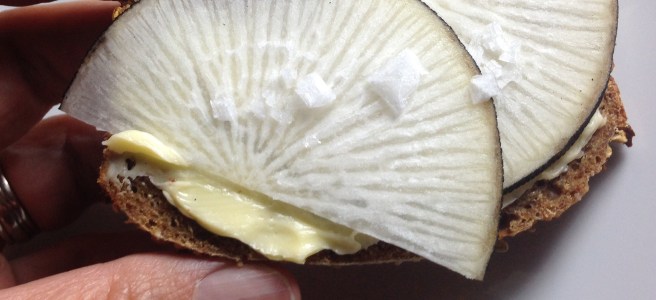
slice of borodinsky bread with butter, black radish, and salt

Last Saturday, I impulse bought a black radish. (These things happen in root vegetable season.) Once I had the black radish, I started day-dreaming about Russian Black Bread, slathered with butter, and topped with thin slices of black radish and some coarse salt, which someone once told me was the right and proper way to eat a black radish. The only trouble was I didn’t have any black bread and I didn’t know how to make it. All I had was a radish (well…, and some rye flour).

After a web search or two for black bread recipes, I found myself overwhelmed by options, so I also consulted a couple awesome friends with Eastern European roots. While neither of them had a family recipe handy, one did help me narrow down my choices. I decided to try something like this Borodinsky Bread, because I was hoping for something with 100% rye.

Over the next four days, I built up a rye sourdough starter. I mixed ~25g of rye flour with ~50g of room temp. water and let it sit out on the counter in a loosely capped plastic container, adding another round of flour and water daily. It started bubbling noticeably the second day. I was getting slowly closer to actually eating my radish.

When I had >270g of sourdough starter, I mixed my dough. (After which I realized the directions I was working from had skipped the step where you simply use ~50g of starter and add equal parts flour and water to make the required 270g. Oh well. Here is the much better description of the same recipe, which I found too late.)

Here’s how it went:

  • 270g rye sourdough starter
  • 230g rye flour
  • 5g sea salt
  • 5g toasted caraway seeds, cracked
  • 20g molasses
  • 15g sorghum syrup (original recipe used barley malt, but I happened to have sorghum so I tried it)
  • 90g water
  • butter for the pan
  • 5g toasted coriander, cracked

Combined everything but the coriander and mixed throughly, but not exactly kneaded. Proofed in a cool room (the basement in November) overnight. It, uh, didn’t rise much.

The next morning I buttered a small (1lb) loaf pan and put half the cracked coriander in it, shaking to get coriander on the sides and the bottom. I shaped the very, very sticky dough into an oval, more or less, and plunked it in the pan. Then I  wet my fingers and smoothed the top, then sprinkled it with the remaining coriander. Covered with a towel and let sit in a sunny spot on the kitchen counter for about four hours. It, once again, didn’t rise much. (I either need to work on my starter’s vigor or add yeast or simply decide that 100% rye bread is meant to be really dense.)

Baked at 400ºF for 10 minutes. Reduced heat to 350ºF and baked for 40 minutes more. Immediately flipped it out of the pan and cooled on a rack.

And then I (finally) had a slice with butter, salt, and radish, and it was pretty darn good.

Good News for Sidewalk Snackers

My family doesn’t tend to eat as much fruit and greens by the side of the road here in New England as we used to when we lived in Berkeley (blackberries and sour grass everywhere), and I haven’t yet managed to join a local forage and can society*, but I was still glad to read this piece from Civil Eats saying that urban foraged food is, basically, fine in terms of contaminants and may even have more micronutrients than some produce found in a store. Maybe next spring (and summer and fall) I’ll forage a bit more.


*This exists! Which is awesome. We also, apparently, have foraging tours by David Craft, who wrote URBAN FORAGING – Finding and eating wild plants in the city, though no more events in 2015.

This Is Not Neil Gaiman’s Porridge (Overnight Oats)

Neil Gaiman allegedly makes the World’s Best Porridge, which I thought I remembered was pretty much the way I make it, until I went back and read the recipe. Turns out I don’t really make it the world’s best way, though both Mr. Gaiman and I use butter.  My porridge may not be the best, but it’s pretty good and makes me happy on cold mornings, particularly on cold mornings when my spouse isn’t home to feed the kids breakfast, like tomorrow will. I am not good at feeding kids breakfast before I’ve had my coffee; it helps to have a plan.

I probably started making porridge this way in one of my spates of reading about Weston A Price. I’m not totally convinced that phytic acid is all that bad for me, but soaking grains, with or without whey, sure does make them cook faster in the morning, so I still do it.

Pretty Good Overnight Oats

  • 1/4 steel cut oats (or blend of steel cut and rolled or maybe even rolled something else like triticale) per person
  • some butter (~1 tsp per 1/4 cup oats)
  • some salt (a good pinch per 1/4 cup oats)
  • some optional whey or yogurt (~1.5 tsp per 1/4 cup oats)
  • 3/4 cup water per 1/4 cup oats
  • chopped fruit, nuts, maple syrup, brown sugar, cream, etc. for serving

The night before: In a saucepan that will happily hold the amount of oats you’re making, melt the butter over medium heat, then toast the oats in the butter until your kitchen smells like delicious oatmeal cookies. Turn off heat and add the salt, optional whey, and water. Cover.

The morning of: Bring to a simmer and cook until done, which shouldn’t take long (5 to 10 minutes), stirring occasionally. Serve with your favorite add-ins.