Home Again, Home Again – Chili and Cornbread

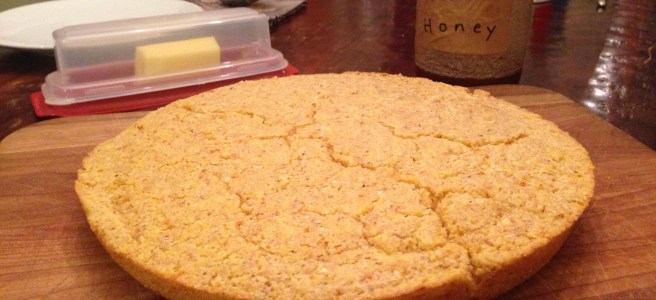
a round of cronbread with honey and butter in the background

We’re home from our American Thanksgiving gallivants, and dinner tonight is comfort food. For us, comfort food is often chili and cornbread*.

Chili is not really a recipe. Tonight’s has: onions, garlic, Serranos from the garden, salt, cumin, ancho chili, smoked paprika, epazote, yellow paprika, cocoa powder, ground beef, and crushed tomatoes. Other nights might have a different combination of peppers, maybe no epazote, and beans. Tonight’s would also have kale, if I had any, because I have a bad habit of sneaking kale into many things**.

My basic cornbread is pretty much just that, basic. I’m too much of a Northerner to claim any special cornbread skills or lore. It is good though.

  • 6 oz. corn meal
  • 2 oz. whole wheat flour (or other flour)
  • 1 1/2 tsp baking powder
  • 1/2 tsp salt
  • 1/2 tsp Aleppo Pepper***
  • 8 oz (1 c.) milk (any kind)
  • 2 eggs
  • 4 0z. butter, plus a little for the pan

If you have a 8 to 10 inch cast iron skillet, put the cold butter in the skillet and put the skillet in the oven before preheating. (If not, just butter an 8 or 9 inch square or round pan.) Preheat oven (and skillet) to 350º.

Whisk together the dry ingredients in a medium sized bowl. In a separate container (that will hold at least two cups), whisk together the eggs and milk. Once the butter is melted (melt it separately if not using a cast iron skillet), whisk it into the milk and eggs. (Put the skillet back in the oven while doing the final mixing.) Fold together the liquid and dry ingredients until just mixed. Scrape into the prepared pan and bake until firm and lightly browned, ~20 minutes.


*I also almost immediately made banana bread from the bananas that had languished here while we were out. It was almost as immediately gone. I’d share that recipe, but I just use one of Smitten Kitchen’s, so really you should just get it from her.

**Because I actually like kale.

***Here’s a connection I often think about when opening my spice drawer – Aleppo Pepper is originally from Aleppo, Syria. Syrian supplies have dried up due to the war there. I get Aleppo Pepper from Penzey’s, which imports it from Turkey, but I still never use it without thinking how global our connections are and without hoping for peace the people of Syria.
Pizza Dough, Revisited Already

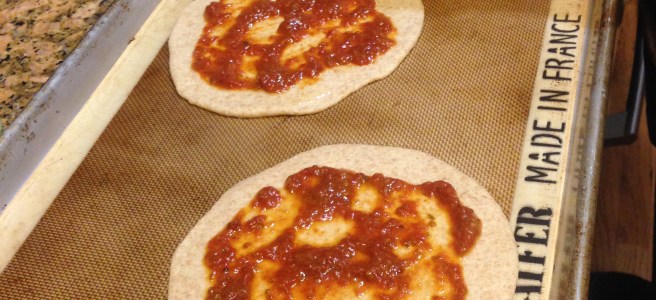
rounds of pizza dough spread with tomato sauce

So yesterday I told you how I make pizza dough, but I left out a few notes and sounded way to authoritative about some details. The most important note is: it doesn’t really matter! You can make homemade pizza crust out of just about any bread recipe. You can buy pizza dough in the freezer section of your grocery store. You can use par-baked pizza crusts. You can order delivery pizza. Just do have dinner. Dinner is a great idea.

The dough I usually make can be summed up as “60% hydration”. That’s actually how I remember it. Hydration refers to how much liquid you have in relation to flour. You may also see the term “Baker’s Percentage”. This is all a useful way to think about various bread doughs. Higher hydration is a really wet dough, harder to knead, prone to bigger holes, generally reserved for slow rise, rustic breads like sourdough. Lower hydration is for tighter crumb sandwich breads. The more you make bread, the better idea you’ll get of what sort of hydration you like for what. 60% gives me a really easy to handle dough which is great for make-your-own-pizza, especially when folks want to roll (or toss!) their own crust. A bit wetter or drier would also be fine.

1 tsp active dry yeast works well for about a pound of flour, when you want your dough to rise pretty quickly. Less would make for a slower rise. More could be even quicker. Eventually, you’ll taste too much yeast, however, so don’t go overboard unless you really like the taste of yeast. (On the other end of the spectrum, if you have sourdough starter and more time, you can make overnight dough instead.)

The olive oil I use is actually more like a “glug” than an ounce. I weighed my usual glug and it’s about an ounce, but the precision really doesn’t matter. I find a bit of olive oil makes the dough just a bit more pizza-y, while acknowledging that this is nowhere near traditional pizza dough at all.

Always add salt. This one is a rule. Saltless bread (or pizza or flat bread or…) is a sad, sad thing. The 2 tsp bit in my recipe is approximate though. A bit less or more would be fine. Oh, and also don’t add the salt right on top of your yeast. Yeast likes its salt a bit buffered, so add the salt late, or well mixed with the flour.

Rising times are extremely forgiving for a simple, yeasted dough. An hour or two on the counter works. Just throwing it in the fridge (covered) works. Taking it out a hour before baking is a good idea, but you can probably get away with skipping that too.

Baking time and temperature are also pretty flexible. Lower temp? Bake a bit longer. Higher? Shorter. Check it after ~8 minutes and see.

Oh, and lastly? Put whatever you want on top. Tomato sauce and pepperoni is great! So is olive oil, mozzarella cheese, and mushrooms. So is sliced apple, cheddar, and sage. So is…

Experimenting is awesome.


Pizza Fridays (the Dough)

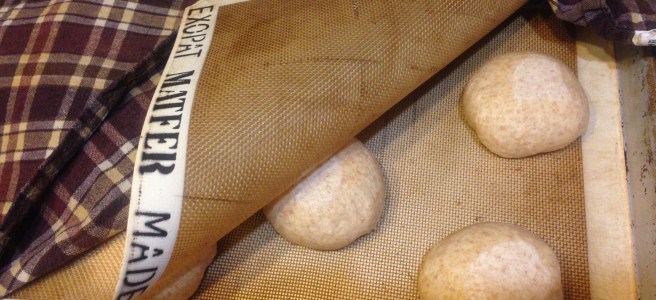
three rounds of pizza dough showing between two silpats

Family meal planning (really any meal planning) is a heck of a lot easier with recurring parameters. We’ve been doing Taco Tuesday almost every Tuesday since we saw the Lego Movie*. We’re trying to do Meatless Mondays more regularly. Friday? Friday is Pizza Night.

I picked up the habit of pizza night from my sister, whose household has a regular pizza and movie night. The beauty of pizza night is it can be as simple as getting delivery pizza and eating it out of the box and it is easily adapted to the “choose your own adventure” model of family dinner.

When I have time, we do make your own pizza on a simple homemade crust. This isn’t three-day, naturally leavened, meant for a wood-burning oven in Rome, crust. It’s more let’s maybe eat some whole grains and mostly everyone likes it just fine crust. And most Friday’s that’s just fine.

Pizza Dough

  • 10 oz white bread flour
  • 10 oz spelt or other whole wheat flour
  • 12 oz water, divided
  • 1 oz olive oil
  • 1 tsp active dry yeast
  • 2 tsp salt

At least 2 and 1/2 hours before dinner – Combine the yeast with 4oz of (body temp or cooler) water. Mix flours, yeast, remaining water, and olive oil until they form a rough dough. Add salt and knead for ~5 minutes. (I use my stand mizer with the dough hook, on low.) Let rise in the bowl for 60-90 minutes.

When the dough has roughly doubled (about an hour), punch it down and divide into six or eight equal(ish) size pieces. Form each piece into a ball. If it’s over an hour until you want to bake, put the dough, loosely covered, in the fridge. (I usually space them out on a half sheet pan, on a silpat, which I cover with another silpat and a towel. Lightly oiled plastic wrap over the top also works well.)

About an hour before baking, have your dough balls on the counter, still loosely covered, so they can rise slightly and come to room temperature. Just before baking, form each into more-or-less a flat circle, about 1/4 in thick. Coat with a bit of olive oil, then add sauce and toppings of your choice.

Bake assembled pizzas at 475ºF for about 12 minutes.


*Taco Tuesday, er, Freedom Friday

Add Another Thing

Once upon a time, in a life before kids, I took a short series of cooking classes with John Ash. He’s a nice guy, with a much pickier palate than mine.

I’ve retained three things from those classes, though I only practice two of them:

  • If you blanch your basil for pesto, it will stay green rather than oxidizing. (I never bother.)
  • You can tame raw garlic (for pesto or salad dressing or …) by blanching it in boiling water for about a minute. (This one I do bother with. Tossing individual cloves in a small sauté pan in water to cover is quick and easy and does make a difference.)
  • If a dish doesn’t taste quite right, add a taste element that isn’t yet represented: sweet, salty, bitter, spicy, sour, umami.

That last one, while possibly obvious, is a trick which has saved me from a boring dish countless times. Today, it was squash soup. A simple base of sautéed onions, squash, chicken stock, a middle-eastern spice blend from a friend. This was good! But… it needed something. It had sweet, umami, and a bit of spice. I added some sherry (round and nutty, yet still counts as sour) and it was much better.

Then, of course, my 7 year old refused to even try it (though he did have several servings of salad).

A Bit of a Manifesto

I resist online food writing for a variety of reasons: laziness, fear of inadequacy, actual inadequacy. I also resist because I’m no fan of following (or testing) recipes and because, well, I don’t believe there are real answers to anything; whatever I think today, I may just change my mind tomorrow.

That said, I am creating this space to write about food, and, with luck, to read what you, my mysterious yet possible audience, think about food, because food is one of my favorite things. You won’t find many painstaking recipes here. I hope you’ll find instead something to ponder and, perhaps, some inspiration.

That said, here are some things I think today, and will probably think tomorrow, about food & cooking:

Food connects. If I trace dinner far enough back, I find myself contemplating soil organisms and what feeds them. If I trace dinner wide enough, I find the cultures across the globe that influenced this recipe, or that use of a utensil. Every time I cook, I am linked back through the generations of everyone who has cooked. I am linked to everyone at my table and everyone sharing a table with others, across the globe. Much depends on dinner*.

There is no absolute right. This is true both for how we cook, and for how we eat. Yes, there are the ways things have been done and mostly worked out for most people. There are chemical reactions in baking that are fairly reliable. There are rules; those rules are generally breakable. There is huge variation in what produce tastes like, in how baked goods react to the weather, in what we can afford (not just in terms of money, but also time and effort). There is huge variation in what nourishes us. There is huge variation in what we like.

Every choice I make (about food, about anything) has some angle I haven’t considered, some piece of information I acted without or in spite of. Every area is a grey area. There is always more to learn. I still have to eat, though. I have to decide (over and over and over again). I do what I can, when I can, and I try to let the rest go. There is no perfect.


*“Much Depends on Dinner” is the title of a book by Margaret Visser which I haven’t read, but probably would love.