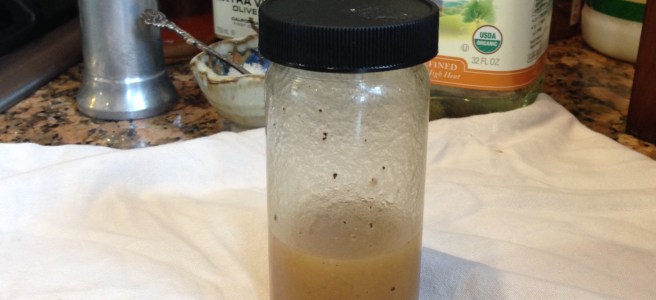
As I think I’ve mentioned before, my family eats a lot of the following salad: arugula, apple, toasted almonds, sherry vin. If we happen to be missing one of the essential ingredients, the basic formula still usually works: leaves, fruit, nuts, vin. If it weren’t for this trick, we’d have a much harder time filling in the “vegetable” part of dinner.
Historically, I’m an incredibly lazy vinaigrette maker. Pour some vinegar in an empty spice jar, add some oil (about 3x the vinegar, but I never measure), add some salt and pepper, maaaaybe add something else to complement the flavors. Shake. Pour on salad and toss. I read recently, in The Food Lab, that emulsified dressing just works better. (The leaves get more evenly coated and wilt less.) I was still too lazy to try it, however, until something else I read, in my kids’ Raddish subscription, pointed out that there exist good dressing emulsifiers other than mustard. Now, I’ve leveled up my dressing game.
Basic Vinaigrette Ratio
- 1 part something acidic: Vinegar, Lemon juice, Wine, etc.
- 3 parts oil
- 1/2 part (or a bit more or a bit less, to taste) something binding or emulsifying: Mustard, Honey, Yogurt, Mayonnaise, Egg Yolk (if you’re using the dressing immediately)
- Seasonings
Add all ingredients to a jar. Shake until well-blended. Pour on salad. Toss.
Some more specific examples:
Honey Mustard: 1 T apple cider vinegar, 3 T sunflower or other neutral oil, 1 tsp dijon mustard, 1 tsp honey, salt, black pepper – good on spinach based salads
Basic Balsamic: 1 T balsamic vinegar, 3 T olive oil, 1 slightly smushed garlic clove, 1 tsp honey, salt, black pepper, maybe some thyme. Add the garlic clove to the vinegar before everything else. If storing before use, remove the garlic after about fifteen minutes.
Sherry Vin: 1 T sherry vinegar, 3 T olive oil, 1 tsp honey, salt, black pepper, the tiniest bit of vanilla paste or extract – really good on salads with apples.
I plan to start experimenting more with yogurt or mayo as the binder. I suspect this will be great with more herb focused dressings (which are great with iceberg, bib lettuce, etc.).
Thanks, Food Lab and Raddish!
 there is no perfect