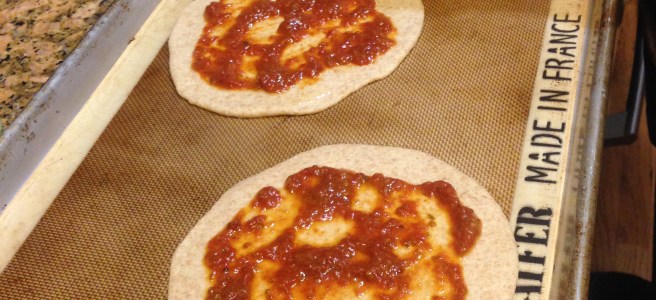
So yesterday I told you how I make pizza dough, but I left out a few notes and sounded way to authoritative about some details. The most important note is: it doesn’t really matter! You can make homemade pizza crust out of just about any bread recipe. You can buy pizza dough in the freezer section of your grocery store. You can use par-baked pizza crusts. You can order delivery pizza. Just do have dinner. Dinner is a great idea.
The dough I usually make can be summed up as “60% hydration”. That’s actually how I remember it. Hydration refers to how much liquid you have in relation to flour. You may also see the term “Baker’s Percentage”. This is all a useful way to think about various bread doughs. Higher hydration is a really wet dough, harder to knead, prone to bigger holes, generally reserved for slow rise, rustic breads like sourdough. Lower hydration is for tighter crumb sandwich breads. The more you make bread, the better idea you’ll get of what sort of hydration you like for what. 60% gives me a really easy to handle dough which is great for make-your-own-pizza, especially when folks want to roll (or toss!) their own crust. A bit wetter or drier would also be fine.
1 tsp active dry yeast works well for about a pound of flour, when you want your dough to rise pretty quickly. Less would make for a slower rise. More could be even quicker. Eventually, you’ll taste too much yeast, however, so don’t go overboard unless you really like the taste of yeast. (On the other end of the spectrum, if you have sourdough starter and more time, you can make overnight dough instead.)
The olive oil I use is actually more like a “glug” than an ounce. I weighed my usual glug and it’s about an ounce, but the precision really doesn’t matter. I find a bit of olive oil makes the dough just a bit more pizza-y, while acknowledging that this is nowhere near traditional pizza dough at all.
Always add salt. This one is a rule. Saltless bread (or pizza or flat bread or…) is a sad, sad thing. The 2 tsp bit in my recipe is approximate though. A bit less or more would be fine. Oh, and also don’t add the salt right on top of your yeast. Yeast likes its salt a bit buffered, so add the salt late, or well mixed with the flour.
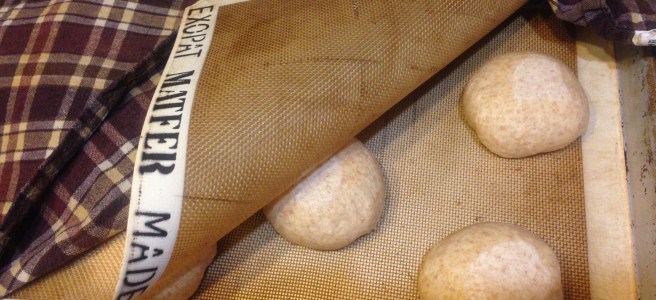
Rising times are extremely forgiving for a simple, yeasted dough. An hour or two on the counter works. Just throwing it in the fridge (covered) works. Taking it out a hour before baking is a good idea, but you can probably get away with skipping that too.
Baking time and temperature are also pretty flexible. Lower temp? Bake a bit longer. Higher? Shorter. Check it after ~8 minutes and see.
Oh, and lastly? Put whatever you want on top. Tomato sauce and pepperoni is great! So is olive oil, mozzarella cheese, and mushrooms. So is sliced apple, cheddar, and sage. So is…
Experimenting is awesome.
 there is no perfect