Almost Awesome Rolls for Christmas Dinner

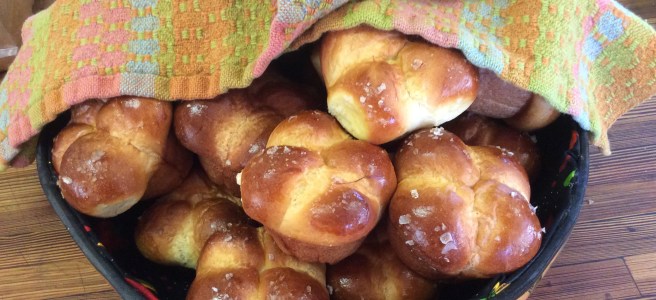
a bowl of rolls with course salt on top covered with a colorful towel

It’s possible I had overly ambitious plans for Christmas Dinner, considering we were traveling cross-country the day before, but it seemed perfectly reasonable at the time: rolls, stuffing, turkey, potatoes, the other things taken care of by other people. It’s also possible I should have chosen a roll recipe that I’d made before. It’s possible I should have drunk my coffee and then started the rolls.* I didn’t though, and thus I made what were beautiful, almost awesome rolls for my mothers-in-law & family for Christmas dinner. Almost awesome even though I forgot the salt.**

Professional kitchen ethos: “Don’t serve anything you’re not proud of.”***

Home dinner party ethos: “Never apologize, never explain.”****

After crying a bit on my spouse’s shoulder over the lost opportunity of making really delicious rolls for Christmas, I went with the second guideline and served the rolls anyway. Next time! they’ll be even better.

Kindred’s Milk Bread Rolls, slightly adapted from Food52

Makes 24-30 rolls

  • 5 1/3 cups bread flour, divided
  • cup heavy cream
  • 1/3 cup mild honey 
  • 3 T nonfat dry milk powder 
  • 2 T active dry yeast 
  • 2 T kosher salt (don’t forget it!!)
  • large eggs, divided
  • 4 T (1/2 stick) unsalted butter, cut into pieces, at room temperature, plus more for coating the pans
  • Flaky sea salt 
  1. Cook 1/3 cup flour and 1 cup water in a small saucepan over medium heat, whisking constantly, until a thick paste forms (almost like a roux but looser), about 5 minutes. Add cream and honey and cook, whisking to blend, until honey dissolves.
  2. Transfer mixture to the bowl of a stand mixer fitted with a dough hook and add milk powder, yeast, kosher salt, 2 eggs, and 5 remaining cups flour. Knead on medium speed until dough is smooth, about 5 minutes. Add butter, a piece at a time, fully incorporating into dough before adding the next piece, until dough is smooth, shiny, and elastic, about 4 minutes.

  3. Form into a smooth ball and leave in the mixer bowl. Cover with plastic wrap and let rise in a warm, draft-free place until doubled in size, about 1 hour.
  4. Butter 24 muffin tins. Turn out dough and divide into 6 pieces. Roll each piece into a cylinder, approximately 1 inch in diameter, and cut into 1 inch sections. They don’t need to be exact. Form each section into a ball and place 4 pieces of dough side-by-side in each muffin cup.
 If you have extra dough and extra muffin tins, make more rolls. If not, just free-form the rest and use them to taste test.
  5. Let shaped dough rise in a warm, draft-free place until doubled in size (dough should be just puffing over top of pan), about 1 hour.
  6. Preheat oven to 375° F. Beat remaining egg with 1 teaspoon. water in a small bowl to blend. Brush top of dough with egg wash and sprinkle with sea salt, if desired. Bake, rotating pan halfway through, until bread is deep golden brown, starting to pull away from the sides of the pan, and is baked through, 17 to 20 minutes for rolls. Let cool slightly in pan on a wire rack before turning out. Serve with a smile.


* The moment when I had both my coffee cup and a cup of flour next to the kneading mixer and, instead of adding a bit more flour when the dough was sticky, I poured in some of my coffee was a good indicator that I wasn’t yet at my Christmas Day best.

** Dear self, you know this one – always, always taste your dough.

*** Quote from Duskie Estes, for whom I had the privilege of working, once upon a time. This idea is also covered really well in what I think of as “the chef speech” in Chef, the movie. I love that movie.

**** Quote which a dear friend of mine attributes to Julia Child (and gently reminds me of every time I apologize at a dinner party). The internet now tells me the actual Julia Child quote is “No matter what happens in the kitchen, never apologize.” That works too.


A Different Winter Warmer – Beef Stock

Ah stock, one of those secret ingredients that make so many things* better, but which always seems like a pain to make. It takes planning ahead. It takes time. It takes bones, for goodness sake. But then, stock really is great stuff. I use it as a base for soups, stews, and chilis, sometimes when cooking beans or rice to make them extra rich, when braising all sorts of things. I even, sometimes, just heat it up with some added ginger or chili and have it for breakfast.

I’m making beef stock today, from stock bones I picked up at the farmers’ market**. It’s pretty simple:

  • 3-6 lbs beef or veal*** bones
  • 1-3 onions
  • 2-4 carrots
  • 3-6 stalks celery – optional if you don’t like this sort of thing
  • other veggies if you have them kicking around, though no brassicas (broccoli, cabbage, kale, etc.) because they’re too strong
  • maybe some garlic
  • ~6 sprigs parsley, or just parsley stems
  • some thyme, either ~6 fresh sprigs or ~1 tsp dried
  • some peppercorns, ~1 tsp
  • a splash of cider vinegar (~2 TBSP)
  • ~1/4 cup tomato paste
  • maybe a dried chili, if you like that sort of thing

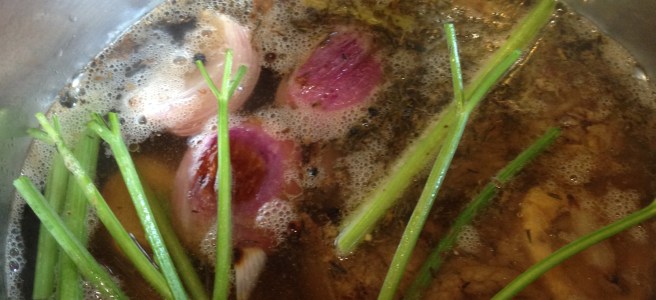
If you have the time and inclination, roast the bones and vegetables at 400ºF or so for 20 to 30 minutes, turning once, until browned. Put everything in a pot and cover with water. (If you roasted the bones and veggies, be sure to scrape all the loving brown bits off your roasting pan into the pot as well. It helps to add some water to deglaze the pan.) Bring to a simmer****. Simmer forever – at least 4 hrs, though 12 hrs is lovely too. Add more water if needed to keep the bones covered, but otherwise ignore it. Strain. Store in fridge or freezer until you want to make soup (or have a lovely warming cup of broth or…).


*Things which are mostly, but not exclusively soups

**Yay! Misty Brook! I’ve also gotten great bones from our awesome local butcher, MF Dulock.

***Yes, veal. Veal is a by-product of dairy, so even if I don’t eat it, it still exists. Misty Brook, and other great farms out there, raise theirs humanely.

****Try not to boil it, because that will make the stock cloudy. Try not to worry too much either. Cloudy stock is still delicious.


Cream Scones, the 2nd – My Favorite

As I mentioned, I have a few go-to scone recipes. This one is my favorite. It’s not as easy as Cream Scones, the 1st, because you need to cut in the butter, but I secretly like cutting in butter, and these are delicious, and I learned them from one of my favorite people in culinary school, so…

Cream Scones (II)

  • 2 c flour
  • 1 T baking powder
  • 1/2 t salt
  • 1/4 cup sugar
  • 4 oz butter
  • 3/4 cup dried fruit
  • 1 1/4 c cream
  • melted butter & coarse sugar

Preheat oven to 425º

Whisk together the dry ingredients, then cut in the butter. (I do this with my fingers, but a pastry cutter, or two knives, or a food processor will also work well.) Add the dried fruit, then the cream, mixing and flattening with a spatula until just forming a rough dough. Turn the dough out onto the counter, then fold it over itself and flatten, repeating until it comes together somewhat uniformly. Shape the dough into two circles, and cut each into 8 wedges.

Place wedges, evenly spaced, on a parchment or silpat lined baking sheet, and brush with melted butter, then sprinkle with coarse sugar. Bake until golden, ~12 to 15 minutes.


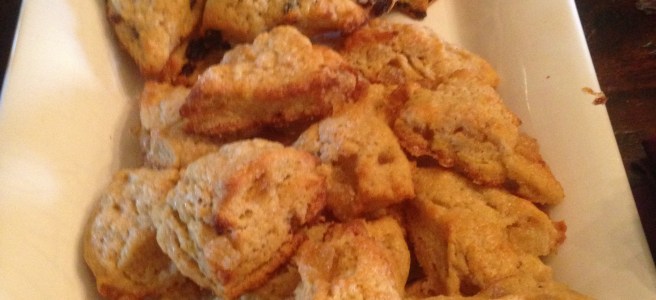
Note: the image used for this post is based on this recipe, but the scones were made mini-sized to serve with a kids’ homemade high tea.


Ubiquitous Kale

“What are you going to blog about today?”

“You could do a review of Steak & Shake.”*

“Nyah, I’m going to write about massaged kale.”

“Kale?”

Yep, kale. Everyone’s favorite hipster vegetable, for mockery if nothing else. I like kale! Though it did take me a decade or two to get there. My kids, like many kids who were toddlers in the last decade, have eaten their share of kale chips. I particularly like massaged kale, which I learned from reading The Revolution Will Not Be Microwaved by Sandor Katz**.

Here are the basics.

Massaged Kale

  • 1 bunch kale, any type
  • vinegar, oil, salt, maybe honey, other things you might put on a salad

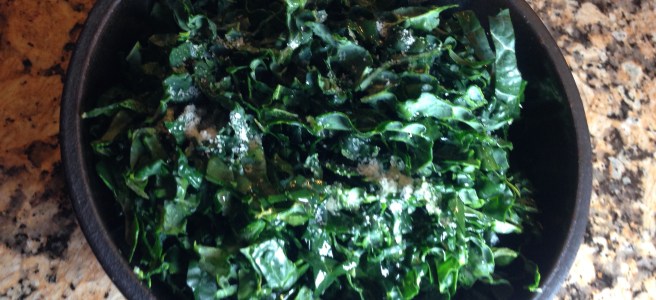
Wash and stem the kale, then cut into very thin, short strips (as thin as you can make them without stressing about it). I do this by stacking the leaves and then cutting across, as thinly as possible. Pile it in a bowl. Add a splash or two of a good vinegar*** and a hearty pinch of salt. 

Now the fun part: squeeze the kale with the salt and vinegar. Squeeze it a lot. Squeeze it a bit more. It should shrink by at least one half. Once it is pretty wet and bright, bright green and much, much smaller, you are done squeezing. It may be hard to get the shreds off your fingers. Add a splash of good olive oil**** and maybe some honey. Stir with a fork, then taste. Add whatever else you like*****. Serve like salad (because it is one).


*actually, Steak & Shake is a pretty great place to go with a party of 12 relatives, after post-holiday go-karting.

**I also like reading Sandor Katz.

***cider! or agro-dolce! or rice! or what have you

****or whatever you like!

*****I like diced apple and toasted walnuts. Something sweet is often good, particularly if you didn’t add the honey.


Cooked Cranberry Sauce

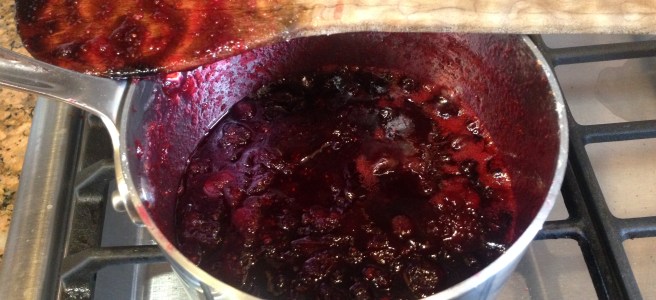
pot with cranberry sauce bubbling on stove with wooden spoon on top

I grew up on store-bought, canned cranberry sauce, the kind you sorta plunk out onto a plate and serve in slices. I love that stuff.

At some point, I decided to see how easy it was to make cranberry sauce myself. Turns out? It’s really easy. I’m certain there are many ways you can make it smoother, more nuanced, fancier, etc., but the basic recipe is: cook some cranberries with some sugar. More specifically, here’s what I just did:

Spiced Cranberry Sauce

  • 4 cups fresh cranberries, picked over and rinsed
  • 2 cups sugar*
  • zest of 3 tangerines (or 1 orange, or…)
  • 1 cinnamon stick
  • 3 cloves

Put everything in a sauce pan with a bit (1/2 cup or maybe less) of water and cook, stirring frequently, over medium heat until boiling. Reduce the heat and simmer until the cranberries mostly burst (or a bit longer if you like your cranberry sauce extra thick). Done.

Store in the refrigerator or can** like other fruit jams.

This yielded 3 and 1/2 cups. Would have been 4 if I’d cooked it down less.


*That’s 2 parts fruit, 1 part sugar, which just happens to be my standard jam ratio.

**I can mine, because I tend to travel for Thanksgiving and having it sealed makes that easier. This stuff will keep almost forever, though, so it’s not necessary unless you’ll be away from a refrigerator for a while or want a good seal.